A sourcing project is easier to manage when its map shows what must be decided, what evidence closes each decision, and who owns the handoff to the next stage. A timeline alone can show when a sample or shipment is expected, but it may hide unresolved specifications, approval gaps, or document dependencies. Start with the brief, connect each milestone to an output, and make changes visible through delivery and receipt.
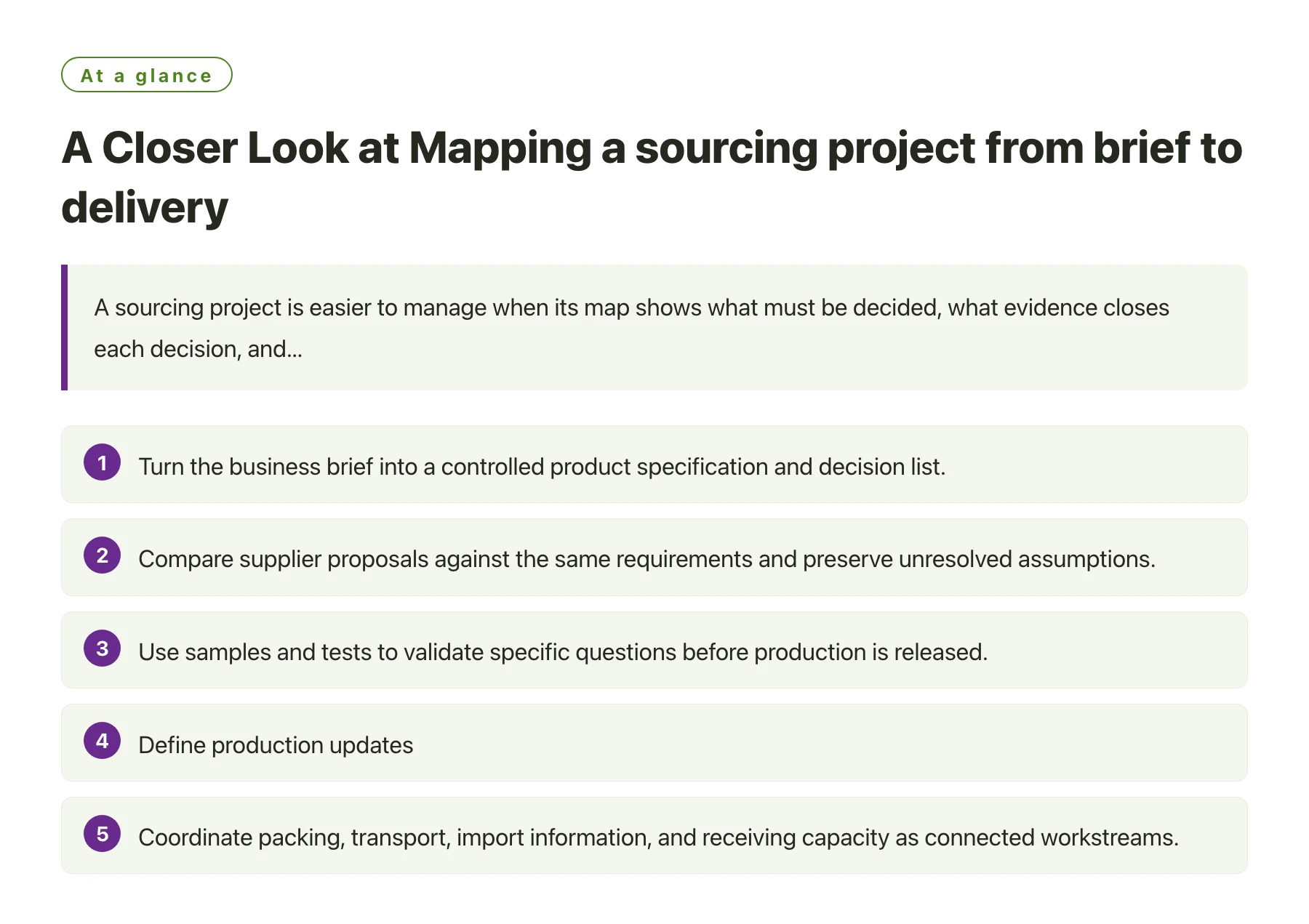
Key takeawaysTurn the business brief into a controlled product specification and decision list. · Compare supplier proposals against the same requirements and preserve unresolved assumptions. · Use samples and tests to validate specific questions before production is released. · Define production updates, inspection stages, acceptance criteria, and change approval in the order documents. · Coordinate packing, transport, import information, and receiving capacity as connected workstreams. · Close the project with a receipt record, issue log, and lessons for repeat orders.
The useful unit of a sourcing plan is not simply a sequence of dates. It is a chain of decisions and evidence: the buyer defines what is needed, suppliers explain how they can meet it, the team validates uncertain points, and the agreed scope moves into production and delivery. A visible handoff between stages helps prevent an assumption made during inquiry from becoming an unexpected cost or delay later.
Turn the brief into a decision-ready requirement
Capture the intended use, customer or project need, target market, product configuration, expected order pattern, budget boundary, schedule, and known constraints. Separate required outcomes from preferences. If a requirement is not yet settled, list the decision owner and due date rather than allowing a supplier to infer the answer. Convert broad descriptions into dimensions, materials, performance criteria, packaging, labeling, or reference samples where those details matter.
Identify the evidence needed before a supplier can be selected and before production can start. A technical drawing may be required to quote tooling, while a market-specific document may be needed before sale. The buyer should confirm product rules with qualified reviewers for the intended market. Keep the brief and specification under revision control so later emails do not contradict the version used for supplier comparison.
The brief is ready for supplier inquiry when a candidate can quote the same scope and the buyer can explain how critical requirements will be checked.
Screen suppliers against the same scope
Create a candidate list based on the manufacturing process, product type, order volume, and service needs. Ask each candidate to identify the contracting entity, production site, proposed process route, relevant experience, subcontracted steps, quotation basis, lead-time assumptions, and evidence available for quality controls. A supplier response is a starting point for review; it should not be treated as an independent verification of every claim.
Use a common response template and mark gaps explicitly. Separate pass-or-fail requirements from trade-offs such as price, order minimum, communication cadence, or customization. If legal identity, site capability, or required documentation remains unknown, keep it visible until resolved. Compare offers on the same product revision and list excluded costs or proposed alternatives before scoring commercial value.
Record why a supplier advances to sample review or negotiation and what conditions remain. A shortlist decision is specific to this product and order; it should not imply that the supplier is approved for unrelated products or future production without further review.
Use samples to reduce specific uncertainty
Before ordering a sample, decide what it should prove: appearance, dimensions, material, function, assembly, packaging, or a combination. Assign the sample a model or revision, and ask whether it uses production-intent tooling, materials, and process. A prototype can validate a design detail while leaving production capacity or recurring consistency untested, so write down its scope and limits.
Create acceptance notes that include the reviewer, test condition, result, deviation, and decision. If a sample fails, choose whether to revise the design, request a corrected sample, approve a documented deviation, or stop the candidate from advancing. When performance or regulatory evidence is needed, use the applicable test method and reviewer rather than treating a visual check as a substitute.
Keep the approved sample, signed record, or controlled photographs available to the people inspecting production. If a change is later made to material, component, finish, or process, decide whether it requires new sample approval or testing.
Release production with clear controls
The purchase order and its appendices should reflect the approved specification, configuration, quantities, price basis, delivery assumptions, documents, packaging, acceptance tests, and deviation process. Identify who may approve changes and how a supplier must notify the buyer about substitutions or delays. State which inspection stage is a hold point and what evidence is needed to release goods.
Set update milestones that reveal meaningful changes: material readiness, production start, first-piece review, in-process status where appropriate, packing completion, final inspection, and document readiness. The right checkpoints depend on the product and risk. Avoid asking for updates that produce no evidence or action; specify what information the supplier should report and who will respond to an exception.
If a defect or schedule issue appears, log the affected quantity, lot, evidence, containment step, responsible person, next decision, and due time. Do not let an urgent transport booking erase an unresolved quality hold. A written record lets procurement, engineering, the supplier, and inspection staff work from the same facts.
Connect shipment planning to order readiness
Plan packaging, pickup, consolidation, freight booking, and receiving capacity using the confirmed cargo information. Keep package counts, dimensions, weights, marks, and document references aligned with the actual goods. If a product needs special handling, storage, or labels, repeat those requirements in the carrier and warehouse instructions rather than relying on a detail buried in the original product brief.
For a U.S. import, Customs and Border Protection's importer guidance discusses the information importers should understand and retain for an entry.[1] The responsible importer should confirm its obligations for the particular transaction; buyers shipping elsewhere should consult the relevant customs authority or qualified broker. Customs documents should correspond to the goods and transaction rather than copy estimates that changed during production.
Define what the receiving team will check when cargo arrives: shipment references, package count, visible damage, documents, and any sample-based product inspection that remains. Name who can report a shortage, approve a delivery exception, or place goods on hold. A clear receipt record helps distinguish transport damage from a production issue discovered later.
Close the project and improve the next order
After delivery, reconcile the received quantity with the purchase order and shipment records. Collect unresolved test results, warranties or manuals where applicable, corrective actions, and supplier documents into a project file. Record late changes, avoidable waiting, quality findings, and document corrections while the people involved still remember what happened.
For repeat purchases, identify which specifications and controls should carry forward and which assumptions need a fresh check. A change in design, destination, process, quantity, or supplier site can make earlier evidence incomplete. Keep the original decision record and issue a new revision rather than overwriting history.
Teams coordinating supplier identification, communication, inspection scheduling, and shipping can review JS Sourcing China sourcing agent against the responsibilities in their project map. Define which tasks are delegated and retain clear buyer ownership of product requirements, contract commitments, and final acceptance.
Sources
Frequently asked questions
What is the most important milestone in a sourcing project?
There is no single milestone for every order. The important checkpoints are the decisions that release risk or commit money, such as specification approval, supplier selection, sample approval, production release, inspection release, and shipment handoff.
Should the timeline be finalized before supplier selection?
Set a target schedule and identify dependencies, then validate supplier lead-time assumptions during comparison. Keep dates provisional until scope, sample, production, inspection, and transport assumptions are aligned.
Can one inspection cover the whole project?
Usually not. A pre-production sample, in-process check, final inspection, and receiving review answer different questions. Choose stages based on product risk and define what each one proves.
What should be retained after delivery?
Keep the approved specification and revisions, supplier quote and deviations, sample or test approvals, production and inspection records, shipping documents, receipt notes, and any open corrective actions.