How the Pool Dashboard Answers One Question: When Is 0.05 BTC Done?
A home miner holding 100 TH/s faces about 1,114.6 days before 0.05 BTC accumulates at current difficulty, while 500 TH/s shortens the same wait to 222.9 days. Those spans come straight from dividing the target by daily output, and the pool dashboard explains why any single week can still surprise. Here is how to read its two headline figures and set expectations that survive contact with variance.
Key takeaways
- At 50 TH/s, 0.05 BTC needs 2,229.1 days, since each terahash yields about 0.00000044865 BTC a day.
- 100 TH/s halves that wait to 1,114.6 days, and 500 TH/s cuts it to 222.9 days at 1,003 EH/s.
- Pool Hashrate shows the pool's current slice of the network; Pool Luck shows how recent blocks compare with statistical expectation.
- Payout rhythm depends on settlement: PPS+ credits hourly, while PPLNS pays after 6 confirmations.
Two dashboard figures that explain most surprises
Open the pool's live view and two numbers dominate: the Pool Hashrate, which states how much hashing power currently reports to the pool, and the Pool Luck value, which compares blocks actually found against the count statistics would predict. The first moves with miners joining and leaving; the second swings with fortune, reading above 100% during kind streaks and below it during dry ones. Beginners often treat both as grades for the pool, but only the first describes capacity, while the second describes weather nobody controls.
The ViaBTC Pool Hashrate display puts those figures beside network totals so a miner can see the pool's slice in context. A pool holding a few percent of 1,003 EH/s finds blocks regularly in aggregate, yet any single miner's credits still arrive share by share rather than block by block. Grasping that separation — pool finds blocks, miners earn shares — dissolves most of the confusion that sends newcomers hunting for a luckier address.
Your personal slice of the daily 450 BTC
Bitcoin issues 3.125 BTC per block across 144 blocks a day, fixing the network-wide day at 450 BTC before fees. Your hardware claims a fraction equal to its hashrate divided by the network total, and that fraction is the entire story of expected output. At 50 TH/s the fraction is 50 over 1,003,000,000, giving 0.00002243 BTC a day. Nothing about pool choice alters that slice; choice of pool alters the fee lines around it and the rhythm in which it arrives.
Scale the slice and the table below emerges naturally. Each doubling of hashrate halves the wait toward any fixed target, which is why the jump from a single older unit to a modest modern fleet transforms the calendar so dramatically. The arithmetic flatters nobody and insults nobody — it simply converts terahash into dates, leaving the miner to decide whether those dates suit the power bill.
Why five hundredths of a coin takes this long
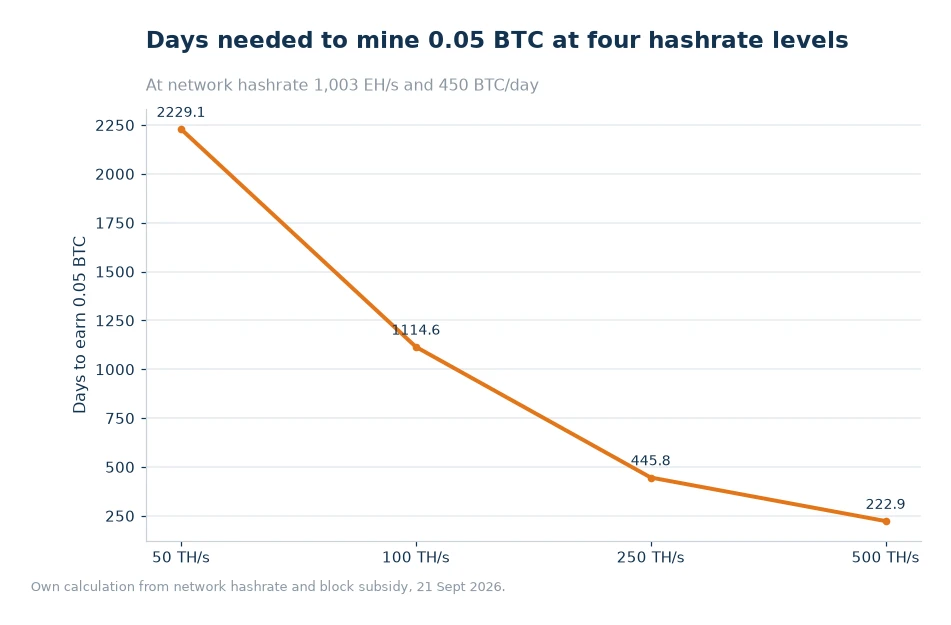
The chart behind this piece plots the wait for 0.05 BTC at four rungs, and the shape surprises first-time readers: the curve falls steeply at first, then flattens, because each added terahash matters most when the total is small. Moving from 50 to 100 TH/s erases over a thousand days from the wait, while moving from 250 to 500 TH/s erases about 223. Diminishing returns govern every upgrade, so later purchases should be judged on margin per dollar rather than on the thrill of the first doubling.
Those waits assume continuous hashing at rated speed with difficulty frozen, which reality will not oblige. Difficulty retargets roughly every fortnight — the coming adjustment was recently estimated near −2.12% — and any sustained rise stretches all four waits while any fall compresses them. Treat the table as a compass bearing rather than an arrival timetable: it points correctly even as the terrain shifts underfoot.
Fortune is weather, not a lever you pull
Pool Luck below par for a week tempts miners to move, yet the mathematics of large pools says otherwise. Your credited shares under PPS+ settle hourly against current difficulty regardless of whether the pool itself enjoyed a lucky stretch, because the operator absorbs that variance and charges the listed lines for doing so. Under PPLNS the luck passes through to miners instead, with payouts after 6 confirmations and shares counted across the last 5 difficulty rounds. Knowing which arrangement you chose tells you whether a luck dip should even appear in your statement.
Chasing lucky pools is therefore mostly theatre for small miners: the expected value follows hashrate and difficulty, while the noise follows sample size. A miner holding 100 TH/s experiences far more relative wobble than the pool aggregate, simply because fewer shares mean wider percentage swings. The cure is longer measurement windows, not more frequent pool changes, each of which resets your baseline and donates a day of attention to reconfiguration. The Profit Calculator restates any tier as daily dollars, and the published fee breakdown shows which listed lines each settlement applies.
A weekly glance that keeps nerves steady
Check the dashboard on a schedule and write down three numbers: your average hashrate, the pool's hashrate, and coins credited that week. Over a month, the ratio of credited to expected coins converges toward the fee-adjusted line, and the weekly luck readings average out into background noise. That notebook habit converts the dashboard from an anxiety machine into an instrument panel, which is its proper role.
Act only on persistent, specific deviations. Hashrate stuck well below the unit's rating across days means heat, dust, failing boards or a throttled supply — all worth a physical inspection. Credits tracking hashrate faithfully while the coin count disappoints means difficulty rose or price fell, which no pool switch can repair. Diagnose the layer the data points at, fix that layer, and leave the rest alone.
| Hashrate | Daily BTC | Days to 0.05 BTC | Share of network |
|---|---|---|---|
| 50 TH/s | 0.00002243 | 2,229.1 | 0.0000050% |
| 100 TH/s | 0.00004486 | 1,114.6 | 0.0000100% |
| 250 TH/s | 0.00011215 | 445.8 | 0.0000249% |
| 500 TH/s | 0.00022430 | 222.9 | 0.0000499% |
Worked example
Derive the bottom row from scratch. Each terahash earns 450 divided by 1,003,000,000 BTC a day, which is 0.00000044865 BTC. At 50 TH/s the day holds 50 times that, or 0.00002243 BTC. Dividing the 0.05 BTC target by the daily 0.00002243 BTC gives 2,229.1 days. The chart records exactly this span for its opening point.
Repeat the division up the ladder and the remaining points land on their marks. At 100 TH/s the daily 0.00004486 BTC implies 1,114.6 days; at 250 TH/s the daily 0.00011215 BTC implies 445.8 days; at 500 TH/s the daily 0.00022430 BTC implies 222.9 days. The chart note states the per-terahash day as 4.5e-07, a rounded form of the same divisor, and every row above follows from it without further assumption.
Frequently asked questions
How long until 0.05 BTC at 100 TH/s?
About 1,114.6 days of continuous hashing at current difficulty, since 100 TH/s earns roughly 0.00004486 BTC a day before pool lines.
Does Pool Luck change what I should expect?
Under PPS+ your hourly credits follow difficulty rather than pool fortune, while under PPLNS luck passes through across the last 5 difficulty rounds with payouts after 6 confirmations.
Why does doubling hashrate not always feel like doubling?
Expected coins do double, but difficulty moves and power costs scale too, so the calendar improvement only survives if the extra terahash runs near rated speed without interruption.
Judge quarters, not afternoons
Pin the table's row for your tier to the wall and compare monthly averages against it. Months inside a narrow band of expectation confirm a healthy setup; months far adrift invite a specific diagnosis rather than a vague pool change. The dashboard rewards readers who visit weekly with a notebook, and punishes visitors who arrive hourly with a mood.
When an upgrade is on the table, price it in days removed from the wait, not in terahash added to the shelf. A purchase that erases a thousand days for little money is arithmetic worth doing; one that shaves weeks at great expense is enthusiasm wearing a spreadsheet costume.
Sources: ViaBTC pool and fee pages for the Pool Hashrate display, Pool Luck context and the listed PPS+ and PPLNS lines; chain inputs read 21 Sept 2026 (network 1,003 EH/s, difficulty 132.76 T, subsidy 3.125 BTC per block, 144 blocks a day), published 24 Oct 2026[1].