PV Cable Certification: What TÜV, IEC and CPR Each Cover
Three certification names do three different jobs on a photovoltaic cable, and the manufacturer's own pages show how they stack. KUKA CABLE lists more than 30 types of certificates including TUV, IEC, CE, SAA and UL, names TUV 2PfG 1169/08.2007, EN 50618:2014 and IEC 62930 on its 1500 V specification, and distinguishes CPR as a fire rating and AD8 as a waterproofing rating. The same pages state that TUV certification is the starting point and that certified performance is expected to hold for more than 25 years, which is why they belong on any pv cable enquiry.
Key takeaways
- Certificates page: more than 30 types including TUV, IEC, CE, SAA and UL, with the UL document described as being updated.
- Standards named on the 1500 V specification: TUV 2PfG 1169/08.2007, EN 50618:2014 and IEC 62930.
- Regional requirements the site highlights: CPR for fire rating and AD8 for waterproofing.
- Certified performance is described as stable for more than 25 years, while one product page states an expected 30 years.
What a certificate is actually for
A certificate is a document that connects one model of cable to one standard and one testing regime. That sounds obvious, and it is the detail most quotations leave out: a supplier may hold a valid certificate for a 4 mm² single-core cable and quote a twin-core assembly without saying whether the certificate covers it. The manufacturer's approach is easy to check because both halves are published. The standards row names the documents, and the model names on the site include H1Z2Z2-K, PV1-F and UL 4703 photovoltaic wire alongside the 1500 V cable and the twin-core versions.
The second half of the check is the laboratory behind the document. The manufacturer's speciality cable laboratory has been running since December 2015 and is described as an ISO/IEC 17025 laboratory, and it publishes a test list that covers water resistance, UV accelerated weathering, abrasion, cold bending, cold elongation, tensile testing after ageing, solderability, static flexibility and construction and dimensional checks. A certificate without a test record is a claim; the two together are evidence.
The TUV scheme: the starting point
The site describes TUV certification as the starting point for a photovoltaic cable, and the language is careful. A certified cable is expected to deliver electrical safety, a low fire risk and performance that stays stable for more than 25 years. The names attached to that scheme on the manufacturer's pages are TUV 2PfG 1169/08.2007 on the 1500 V specification, and TUV EN 50618 and PV1-F in the list of common international certifications for photovoltaic cables.
The value of the scheme is that it turns a material argument into a measured one. A TUV file is built from tests, so a buyer who asks which of those tests supports a claim about ageing will get a page reference rather than an adjective. That is also why the elongation figure matters so much here: the European standard requires more than 125% before ageing, and the manufacturer states its photovoltaic cables reach up to 185%.
The IEC documents: conductor, cable and international reach
The IEC family does two jobs on these pages. IEC 62930 is named as the international counterpart of the European photovoltaic cable standard, which is the document a project outside Europe is most likely to ask for. IEC 60228 is named for the conductor itself, where the construction is described as tinned copper of class 5 flexibility. Both matter because they describe different layers of the same product: one governs the finished cable, the other governs the strands inside it.
The site's certificates page adds the wider picture, listing more than 30 types of certificates including TUV, IEC, CE, SAA and UL, and noting that the UL document is in the process of being updated. For a North American project there is a dedicated model page for UL 4703 photovoltaic wire, which is the document that market asks about first.
CPR, AD8 and the regional layer
Fire performance is handled differently in different markets, and the manufacturer describes two ratings that sit outside the cable standards. CPR is presented as a fire-rating requirement, and AD8 as a waterproofing rating, and both are highlighted on the site's solar cable topic page rather than on the product datasheet. That placement is a clue about how they work: these are requirements a project imposes, and a manufacturer answers them with a classification rather than with a general statement about flame behaviour.
The published flame test is worth reading beside them. A single cable is exposed to vertical burning at 800 °C for one minute and is expected to self-extinguish. That is a laboratory description of behaviour, not a classification, so a project that needs a CPR class should ask for the classification document that covers the offered model. The same logic applies to AD8: a waterproofing rating is a value to confirm, not an assumption to make from the word waterproof.
| Document or scheme | Where the pages place it | What the pages state about it |
|---|---|---|
| TUV 2PfG 1169/08.2007 | 1500 V solar cable specification | Named in the standards row of the datasheet |
| TUV EN 50618 and PV1-F | List of common certifications | Listed among the international certifications for photovoltaic cables |
| IEC 62930 | 1500 V solar cable specification | Named as the international counterpart |
| IEC 60228 | Conductor description | Class 5 flexible tinned copper |
| UL 4703 | Model page and certificates page | A photovoltaic wire model, with the UL document being updated |
| CPR and AD8 | Solar cable topic page | Fire rating and waterproofing rating highlighted as regional requirements |
Worked example
Take the two service-life figures the site publishes and put them against a project life. If a certification scheme is described as supporting stable performance for more than 25 years, and a product page states an expected life of 30 years, the difference is 30 − 25 = 5 years of headroom over the certified figure; that subtraction is mine, and it compares two published statements rather than two measurements.
Turn the same comparison into days and the scale becomes clearer. Twenty-five years is 25 × 365 = 9,125 days, and 30 years is 10,950 days, so the published expectation is 1,825 days longer than the certified figure. Both multiplications are mine and both assume 365-day years. The point is not that one number is wrong; it is that a design life belongs on the order so the supplier knows which of the two is being relied on.
The published life figures on one chart
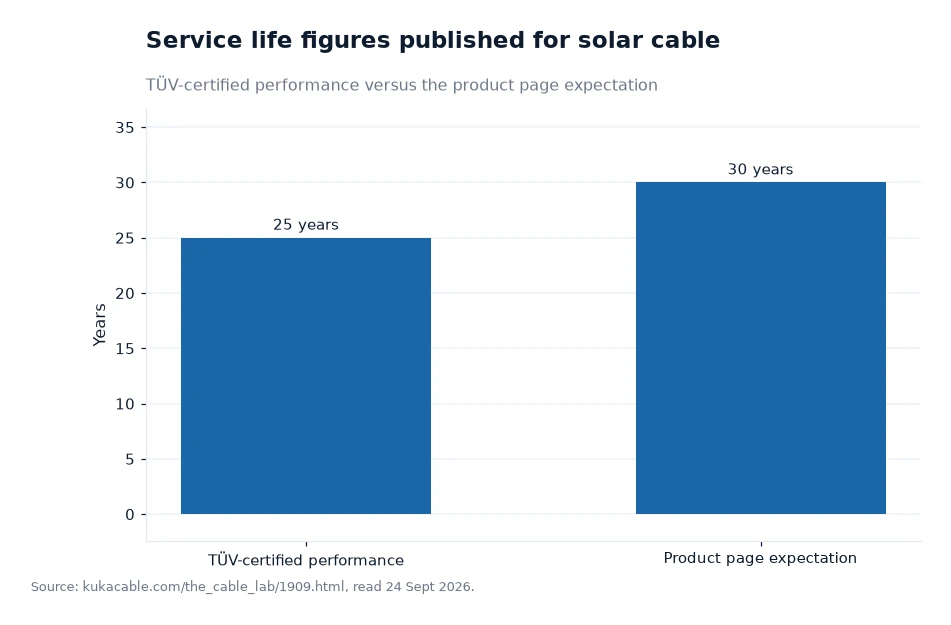
These bars describe time, not certification scope, and they are shown here as the manufacturer's published service-life statements rather than as a property of any one certificate. Their usefulness is that both are conservative in the direction a buyer wants: the lower bar is tied to the certified performance claim, and the higher one to a product expectation. A specification writer can therefore choose the figure that matches the warranty or design life being planned, instead of being handed a single number with no source.
Frequently asked questions
Does a TUV certificate cover the CPR fire rating?
No. The site presents them as separate things: TUV is described as the certification starting point and CPR as a fire-rating requirement in certain markets, with AD8 covering waterproofing. A project that needs a CPR class should ask for the classification document that applies to the model being supplied.
How many certificates does the manufacturer list?
The certificates page lists more than 30 types of certificates including TUV, IEC, CE, SAA and UL, and describes the UL document as being updated. The site does not publish certificate numbers, so the copy that covers the offered model has to be requested with the quotation.
Building the certification file for a project
Ask three questions in the enquiry and keep the answers together. Which standard, with its year, governs the model offered? Which test record supports the ageing and temperature values on the datasheet? Which regional documents, such as CPR or AD8, apply in the destination market? Then add the two published figures that most often decide a comparison, the elongation before ageing of up to 185% and the service-life statement of more than 25 years, and ask the supplier to confirm both against the certificate copy rather than against a brochure.
Certificate names and the 25-year service-life statement are drawn from the manufacturer's own website pages, whose read date is 24 Sept 2026[1].