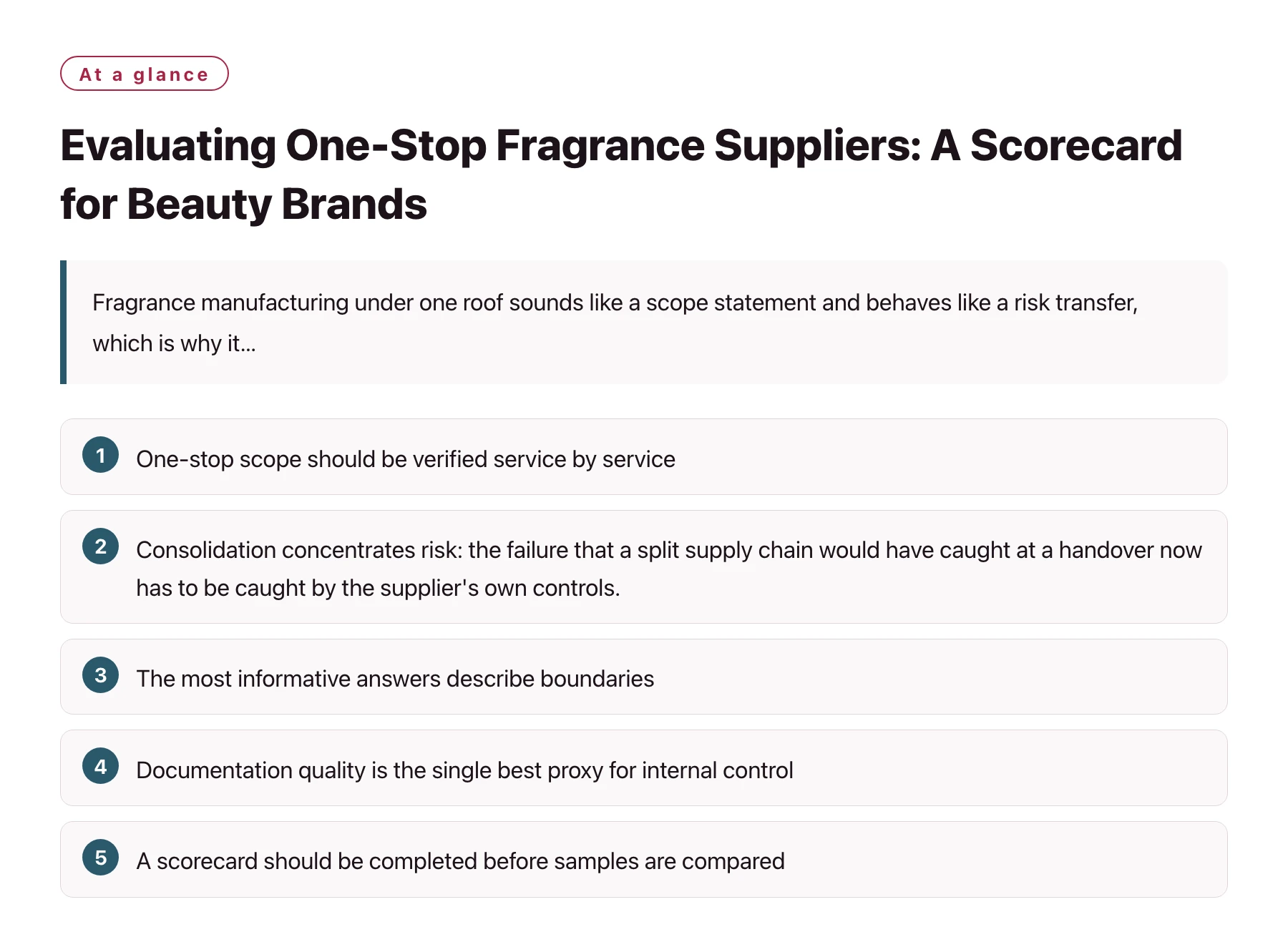
Fragrance manufacturing under one roof sounds like a scope statement and behaves like a risk transfer, which is why it has to be evaluated rather than accepted. Consolidating development, compounding, filling and packaging with one supplier removes handovers, and it also removes the checks that handovers provide. An established beauty brand therefore evaluates a one-stop supplier on two axes at once: whether the scope is genuinely covered, and whether the internal controls are strong enough to replace the scrutiny that a split supply chain would have imposed. The scorecard below is built to produce evidence on both, and it is deliberately biased towards questions that cannot be answered with an adjective.
Key takeaways
- One-stop scope should be verified service by service, because most suppliers cover a strong majority of the chain and a weak minority of it.
- Consolidation concentrates risk: the failure that a split supply chain would have caught at a handover now has to be caught by the supplier's own controls.
- The most informative answers describe boundaries, dependencies and people, while the least informative describe capability in general terms.
- Documentation quality is the single best proxy for internal control, so a supplier whose records are weak is a poor candidate for consolidation even when its samples are strong.
- A scorecard should be completed before samples are compared, because an impressive sample tends to retroactively inflate every other score.
- Where a supplier scores well on scope but poorly on documentation, the right answer is usually to keep the supplier and add contractual controls rather than to replace it.
Most supplier evaluations fail in the same way. The criteria are reasonable, the meetings are thorough, and the resulting scores cluster so tightly that the comparison produces no decision. That happens because the questions invite impression rather than evidence. How strong is your quality system has only one polite answer.
This scorecard is arranged around a single rule: every criterion must be matched to a question whose answer is a document, a named person or a described sequence. The score is then a note on what was produced, not a judgement of the sales meeting.
It is written from the position of a sourcing consultant who is regularly asked to compare one-stop fragrance suppliers for beauty brands, and who has found that the decisive differences usually appear in the four or five criteria that buyers ask about last.
The scorecard: four columns, six criteria
| Evaluation criterion | Question that produces evidence | What a strong reply looks like | What a weak reply reveals |
|---|---|---|---|
| Scope of the one-stop chain | Which of development, compounding, filling, decoration and packaging does this factory perform itself, and which does it subcontract? | A service-by-service answer with the subcontracted steps named and the reason given | The word complete, without a breakdown of what is performed in house |
| Brief interpretation | Who receives a brief, what do they produce from it, and how long before a direction is proposed? | A named role, a described output such as a technical direction, and an expected interval | A promise that the perfumer will understand the brief once sampling starts |
| Specification and change control | Show the current specification and its revision history for one live project, and describe the change-notification trigger | Dated revisions with reasons, plus a defined trigger and notification window | A final-looking document with no prior versions and a verbal assurance about updates |
| Stability and compatibility testing | Which tests are run before a formula is locked, on which package, and what is done if a result is marginal? | Named tests, the actual container used, and a described escalation route | Reference to testing in general, with no package-specific detail |
| Safety and regulatory support | How is alignment with fragrance safety standards demonstrated, and who signs it? | Category-specific reasoning, the standard version applied, and a responsible person | A blanket statement of compliance with no route to the underlying documentation [1] |
| Timeline ownership | Which stage is the critical path, what is the dependency, and who communicates a slip? | A specific stage named with the dependency and the person responsible for escalation | A total lead time quoted without any stage-level reasoning |
Two criteria in this table carry disproportionate weight. Specification control is the strongest single indicator of internal discipline, because a supplier that versions its documents is running a system rather than a habit. Timeline ownership comes second, because it reveals whether anyone inside the supplier is accountable for the calendar. A brand that scores only those two and leaves the rest blank will still separate most suppliers correctly. Where repeat production history is part of the picture, brands Xuelei has manufactured for is the kind of public material that can be read before any meeting, which reduces the number of questions that need to be asked live.
Running the scorecard so it produces a decision
Two practical rules make the difference between a scorecard that decides and one that decorates. The first is to score before sampling, because a beautiful sample lifts every other judgement retroactively. The second is to score in the same session for every supplier, using the same questions in the same order, so that the notes are comparable rather than merely extensive.
It also helps to record what was not produced. A missing document is data, and a supplier that acknowledges the gap in writing is easier to work with than one that produces something polished and beside the point. That distinction should be visible in the score, not smoothed over.
Convert the score into contractual protections
The output of an evaluation is a negotiating position. A supplier that scores well on scope and moderately on change control should not be rejected; it should be asked to accept a written notification trigger, sample retention for the life of the product, and access to test reports. Those clauses convert a soft finding into a control, and they are far easier to obtain before a programme begins than after a problem has surfaced.
Where a brand is comparing several candidates, the comparison should also account for what each one would cost to manage. A supplier with a weak quality function is not simply riskier; it is more expensive, because the brand absorbs the verification work itself.
Compare the numbers as well as the capabilities
A capability scorecard sits beside a commercial comparison rather than replacing it, and the commercial side needs the same discipline. Quotes that look similar in total often differ in what they include, which is why the cost lines behind a price are worth reading carefully when a brand is choosing between fragrance manufacturing under one roof and split sourcing. Reading comparing fragrance manufacturing quotes line by line, rather than on the single unit figure, is what makes the capability score meaningful in a budget conversation.
The same logic applies to the market a brand is selling into. Where the product will be sold in Europe, the supplier's ability to support labelling and safety documentation is a scored criterion rather than a background assumption, because packaging and safety expectations in that market are set by regulation and enforced at the point of sale [2].
Sources
- EU Scientific Committee on Consumer Safety (SCCS) —— The EU scientific committee that issues opinions on the safety of cosmetic ingredients, including fragrance allergens and their labelling thresholds.
- HAPPI — Household & Personal Products Industry —— An industry magazine covering the household and personal care market, including fragrance, formulation and packaging.
Frequently asked questions
What does fragrance manufacturing under one roof actually cover?
It can cover brief interpretation, development, compounding, filling, decoration and packaging, but the coverage differs by supplier. The reliable way to establish it is to ask service by service which steps are performed in house and which are subcontracted.
Is one-stop sourcing riskier than using several suppliers?
It concentrates risk rather than eliminating it. Handovers that would have caught a problem in a split supply chain are removed, so the supplier's internal documentation and testing have to be strong enough to substitute for them.
What is the most important criterion on the scorecard?
Specification and change control. A supplier that versions its specifications and notifies changes is running a managed system, and that single indicator correlates with everything else that matters on a reorder.
Should samples be evaluated before or after the supplier scorecard?
After. A strong sample tends to lift every other judgement retroactively, which is why the capability assessment should be completed before sampling results are compared.
What should happen when a supplier scores well on scope but poorly on documentation?
Keep the supplier and add controls: a written change-notification trigger, sample retention, access to test reports and a defined non-conformity process. Replacing a capable manufacturer over a fixable documentation gap is usually the more expensive response.